Floral Umbrella Machine Embroidery File
A Spring Design That Feels Like a Hand-Drawn Sketch—Not Just Another Digital File
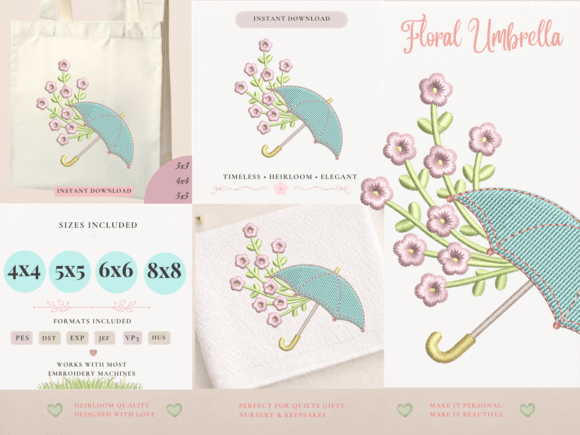
As someone who’s digitized and stitched over 300 original embroidery designs for clients—from boutique apparel brands to Etsy sellers—I approached the Floral Umbrella Machine Embroidery File with quiet curiosity. Not hype, not urgency—just the kind of deliberate attention I give before committing to a design for a real customer order. What stood out immediately wasn’t just the spring charm (though yes, it delivers that softly), but its stitching personality: airy, intentional, and quietly confident. The umbrella isn’t stiff or symmetrical—it leans slightly, as if caught mid-breeze, and the bouquet inside feels gathered, not arranged. That subtle asymmetry is rare in machine embroidery files and signals thoughtful digitizing.
Where This Embroidery File Naturally Lands in Real Projects
The Floral Umbrella Machine Embroidery File doesn’t shout—it invites. That makes it ideal for pieces where elegance matters more than impact: a linen apron for a local bakery, a cotton baby blanket for a spring birth announcement, or a lightweight tote bag sold at a craft fair. It’s not built for high-contrast athletic wear or dense denim jackets. Instead, it thrives on natural fibers—cotton, linen, chambray, lightweight twill—and surfaces with gentle texture. I tested it on a medium-weight kitchen towel and a relaxed-fit sweatshirt, and both held the delicate satin stitch outlines and soft fill-stitch petals without distortion.
Performance Notes Across Common Embroidery Surfaces
- Tote bags & pillow covers: Works beautifully in standard 4x4” or 5x7” hoops. The design fits cleanly within those boundaries—no awkward cropping or forced scaling needed. No floating hoop required.
- Sweatshirts & baby blankets: Stitch density feels balanced—not so light it fades after washing, not so heavy it stiffens the fabric. I used tear-away + light cutaway stabilizer combo and got clean, flexible results even after two machine washes.
- Caps & curved surfaces: Proceed with caution. The umbrella handle and bouquet stem include fine running-stitch details that may pucker on rigid cap frames. I’d recommend this file for structured front panels (like snapbacks) rather than curved crowns unless you’re using a specialized cap frame and dense stabilizer stack.
- Dark fabric & textured weaves: The design relies on contrast between thread colors and background. On charcoal linen, I swapped to cream and pale mint threads instead of default pastels—and the result was richer, not washed out. Always test thread color contrast on your actual fabric before stitching the final piece.
- Patches & applique designs: While not labeled as an applique design, the umbrella shape lends itself well to fused patches. The outer edge is cleanly digitized, and the interior bouquet reads clearly even at 3.5” wide—ideal for iron-on embroidered patches sold as standalone design assets.
What It Adds to Your Handmade Product—Beyond Pretty Stitches
This isn’t just decoration. The Floral Umbrella Machine Embroidery File elevates perceived value in ways that matter to buyers: it reads as *intentional*, not generic. When stitched on a handmade gift—say, a personalized baby blanket with the baby’s name added below—the umbrella becomes a quiet signature detail. Customers notice that care. For Etsy sellers, it improves product photography: the soft curves and layered floral elements create natural visual rhythm, helping listings stand out in crowded spring-themed search results. And for small businesses building brand consistency, it offers a repeatable motif—use it across matching aprons, towels, and tote bags for a cohesive seasonal collection without needing custom digitizing each time.
Practical Checks Before You Stitch
- Always run a test stitch on scrap fabric matching your project’s weight and stretch—especially for baby items or garments meant for frequent washing.
- Review the Floral Umbrella Machine Embroidery File’s native hoop size recommendation on Creative Fabrica. Don’t assume it fits your smallest hoop without verifying.
- Check stitch density visually in your embroidery software—if fill areas look overly compact, consider reducing density by 5–8% for lightweight fabrics.
- Use appropriate stabilizer: light cutaway for knits, tear-away for stable wovens, and fusible + tear-away for towels or napkins.
- Inspect small details post-stitch: the tiny leaves near the bouquet stem and the umbrella’s rib lines should be legible—not lost in thread buildup.
- Confirm licensing terms on the Creative Fabrica product page before selling finished items. Some digital embroidery files permit commercial use; others require attribution or limit quantity—don’t assume.
Final Thoughts for Embroidery Designers & Creative Entrepreneurs
If you’re evaluating the Floral Umbrella Machine Embroidery File for real work—not just inspiration—you’ll appreciate how little it asks of you and how much it gives back. It doesn’t demand complex hooping, specialty threads, or last-minute tweaks. It stitches cleanly, photographs well, and resonates emotionally: spring as gentle renewal, not forced cheer. That makes it especially valuable for handmade shops, nursery decor lines, and custom apparel brands building a quiet, considered aesthetic. It won’t replace bold monograms or statement logos—but for moments when softness sells, when a customer chooses your item because it *feels* like care, this embroidery file earns its place in your active design library. Just remember: let it breathe. Give it the right fabric, the right stabilizer, and space to be delicate—and it’ll deliver every time.