Beach Towel Machine Embroidery Design
A Bold, Timeless Motif That Builds Brand Warmth
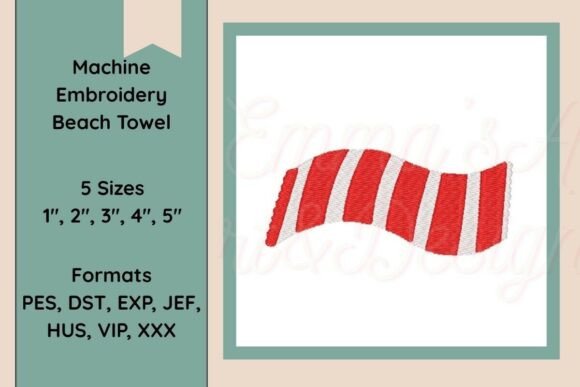
As an embroidery designer who’s developed hundreds of commercial designs for small businesses—from coastal cafés to handmade florist studios—I immediately recognize the quiet power in the Beach Towel Machine Embroidery Design. Its classic red and white stripes paired with a soft wavy motif don’t just evoke summer—they signal approachability, craftsmanship, and joyful consistency. This isn’t a decorative afterthought; it’s a visual handshake. It reads as friendly yet professional, playful without sacrificing polish—ideal for brands that want to feel human, not corporate.
Where This Design Earns Its Keep in Real Business Use
The Beach Towel Machine Embroidery Design shines where small businesses need versatile, recognizable branding: embroidered patches for staff uniforms, chest accents on aprons at a seaside bakery, sleeve details on linen work shirts for a boutique florist, or front-cap embroidery for a pet brand launching a “Sunshine Squad” summer campaign. It scales beautifully onto tote bags used as customer gifts or event merch—its rhythm holds up even when viewed from across a farmers’ market stall.
For Etsy sellers and handmade product creators, this design works as a subtle but memorable signature. Stitched onto the corner of a linen tea towel, woven into the hem of a hand-dyed scarf, or centered on a canvas apron for a ceramic studio—it reinforces authenticity without shouting. As a digital embroidery file, it integrates cleanly into existing design assets, helping maintain visual consistency across custom apparel, packaging accents, and printable mockups shared with clients.
Smart Placement Starts With Smart Limits
While bold and confident, the Beach Towel Machine Embroidery Design does require thoughtful application. Avoid using it below 2.5 inches in width for embroidered patches—its wavy stripe structure begins to lose definition, and stitch density can cause puckering on lightweight fabrics. Cap fronts are viable, but only if the curve is gentle and the hoop size accommodates the full wave contour; tight curves may distort the stripe flow unless digitized with stretch compensation (verify your file includes this).
Be cautious on dark uniforms or textured fabric like heavy twill or corduroy—the red thread must have enough contrast to remain legible after repeated washing. If your small business merch includes high-use items like staff aprons or reusable totes, test the design with recommended stabilizer first: a medium-weight cutaway works best for durability, especially where seam stress meets stripe edges. Also, avoid shrinking it for tiny product labels or tag accents—the motif relies on rhythm and proportion, not micro-detail.
How It Strengthens Your Brand Identity—Not Just Your Merch
In a crowded marketplace, consistency builds trust. The Beach Towel Machine Embroidery Design delivers that through repetition with warmth: same stripes, same wave, same energy across aprons, caps, and tote bags. Customers begin to associate that rhythm with your brand’s care, seasonality, and tactile quality—especially important for handmade product sellers who rely on perceived authenticity.
Unlike trendy graphics that date quickly, this design leans into timelessness. That makes it a long-term asset—not just seasonal decor. A café using it on summer staff uniforms can rotate it into fall merchandise by switching thread colors (navy + cream, sage + oat), extending its lifecycle without redesign costs. For creative studios and local businesses, that flexibility translates directly into higher ROI per digital embroidery file.
Practical Designer Notes Before You Stitch
- Always test in black and white first—this reveals balance, spacing, and outline clarity before color decisions complicate judgment.
- Check small-patch viability by scaling the embroidery file down to 2.0” wide and reviewing stitch lay in your editing software—look for thread stacking or collapsed waves.
- Review thread color contrast on your actual fabric swatches, not just screen previews. Red on heather grey or natural canvas behaves very differently than on pure white.
- Inspect spacing between stripes—tight gaps increase stitch density and risk fabric distortion; generous spacing improves wash durability.
- Confirm hoop size compatibility with your machine and intended placement (e.g., cap frames vs. flat hoops).
- Test on real fabric with your chosen stabilizer and tension settings—especially critical for textured or stretchy materials.
- Create a physical mockup before client approval. A stitched patch on an apron sample tells more than any digital proof.
- Compare it beside your other design assets—does it share weight, rhythm, and tone with your logo or typography? Visual harmony matters more than novelty.
- Verify commercial licensing before applying to paid merchandise, wholesale orders, or Etsy listings. This is non-negotiable for small business merch and commercial embroidery use.
Final Thought: More Than a Summer Trend—It’s a Brand Anchor
The Beach Towel Machine Embroidery Design stands out because it doesn’t chase attention—it earns it. It supports your story instead of overshadowing it. Whether you’re a craft business building community through tactile goods, a local shop expressing seasonal joy, or an embroidery shop curating reliable assets for clients, this design delivers professionalism with personality. It reminds customers that your brand values both quality and charm—and that’s the kind of impression that turns a one-time buyer into a repeat advocate. In the world of small business merch, that’s not just smart embroidery. It’s smart branding.